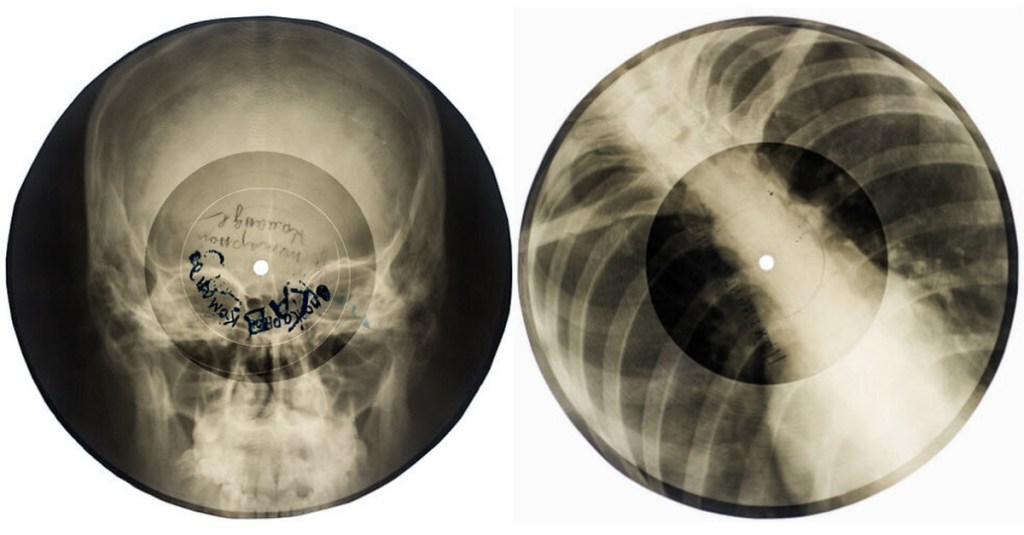
If you’re fortunate enough to live in a country that pretty much lets you listen to whatever music you want, then the idea of clandestine record pressing may sound strange. However, the human need to listen to cool music is insatiable, and one of the most fascinating stories comes from Soviet Russia, where the government tried to control what people listened to, and failed.
In the ’50s and ’60s, music fanatics found a government unwilling to let them rock ‘n’ roll, so inventive solutions were sought, leaving us with ‘Ribs’. These are long players pressed onto x-rays and shared on the black market and between secretive musos.
Sometimes called ‘Jazz on Bones’ or ‘bone music’ (roentgenizdat), these brilliant pieces of improvisational art would be smuggled through Soviet countries, allowing people to listen to artists banned by the state. Those would include The Beatles, Beach Boys, Ella Fitzgerald, Elvis, The Rolling Stones, as well as Pyotr Leshchenko and Alexander Vertinsky.
With x-rays snatched from the bins at hospitals, music was cut into seven inches with the centre hole burned through with a cigarette. They played at 78rpm, and they sold for a ruble and sounded like dogshit. Like dubplates, they didn’t take repeated plays, but that didn’t matter. It was the only way of hearing forbidden music in a pre-internet and home-taping world.
The Soviet powers-that-be passed a law to forbid home recording, and referred to the whole thing as a “criminally hooligan trend”, coming from the word ‘stilyagi’, with the word ‘stil’ referring to Russian kids who were part of a subculture that was dedicated to embracing Western fashions and trends.
And while it’s easy to be taken in by some poor Ruskis being enamoured with us Westerners, the truth is far more exciting. While the Western Yoof were tearing seats up in cinemas watching rock ‘n’ roll movies (that seem pretty tame by modern standards, honestly), imagine the impact these rib records had on Russian and Soviet teens!
Western Europe was inventing Young People post war, and in Russia, they were looking at having to join the youth brigades of the Komsomol, where young men and women were expected to live ‘correctly’ in every aspect of their lives in accordance to the Party’s doctrines. You were basically branded a ‘hooligan’ if you were caught smoking, partying, drinking, or being religious.
The Bolsheviks saw many things as threats to society, and instead, tried to promote volunteer work, keep-fit, political clubs and god, that sounds tedious. Hearing jazz blasting out from a DIY black market x-ray record? You must have felt like the coolest rebel in the whole world! One young man by the name of Rudy Fuchs would give blood and used the money to pay for a recording lathe to make such rib records.
During the Cold War, it was’t just x-rays – young enthusiasts would cut music to anything they could get their hands on. Road signs and cake plinths were also used, and sometimes, the bootleggers would be arrested and accused of being Western informants and all manner of grim nonsense that would see them imprisoned. However, many of them continued undeterred.
The compulsion to distribute music was too strong. The will to not be told what to listen to, even stronger.
How did the LPs make their way into Soviet countries in the first instance? Music was smuggled over borders by sailors and sometimes diplomats, all under the threat of punitive action from the literal KGB. When the ’80s came along, so did the ubiquitous cassette, which is when the real music revolution happened in Soviet countries.
All the while, these bootleggers would have to test would-be buyers to try and weed out the cops. There were tricks and tests to make sure their clients were not police informants, and so, you’d be tested on your knowledge of rock music before anything was handed over. Fail the test, you went empty-handed. Understandable when you’re dealing with an authoritarian regime and it’s attack dogs, less so when you’re dealing with a nerd in Music Zone in Solihull.
Soviet countries, of course, had a music scene of it’s own and some excellent psychedelic folk and jazz, but it’s this footnote that is so unusual and so specific to the Eastern Bloc that’s it’s worth documenting, because the fact is, it doesn’t matter what a government tries to do, pop fans will find a way.
 The Pop Corporation

Leave a comment