
We’ve heard a lot about the woes of the working classes in art and music of late, and it’s true, that it is harder than ever for people from low-income backgrounds to make it to the big stages, lacking the financial cushion of wealthy families while they’re scrabbling to get heard.
Wigan indie band The Lathums are of working stock, and Alex Moore of the group has said “we’re doing really well, and we’re making a life out of it, we’re making a career, but in terms of opportunity and stuff like that, of course its going to be easier for people in certain circles,” and that, the expectations of people from poorer backgrounds is to “get your trades, get your qualifications, go and get an apprenticeship or a job”.
North Shields’ Sam Fender recently referred to the music industry as “rigged” against working class artists due to the costs involved in music.
This all echoes an image that went viral on Instagram and the like, from danwilson1982, taken from a Simon Price quote, which points out the affluent background of recent BRIT winners.
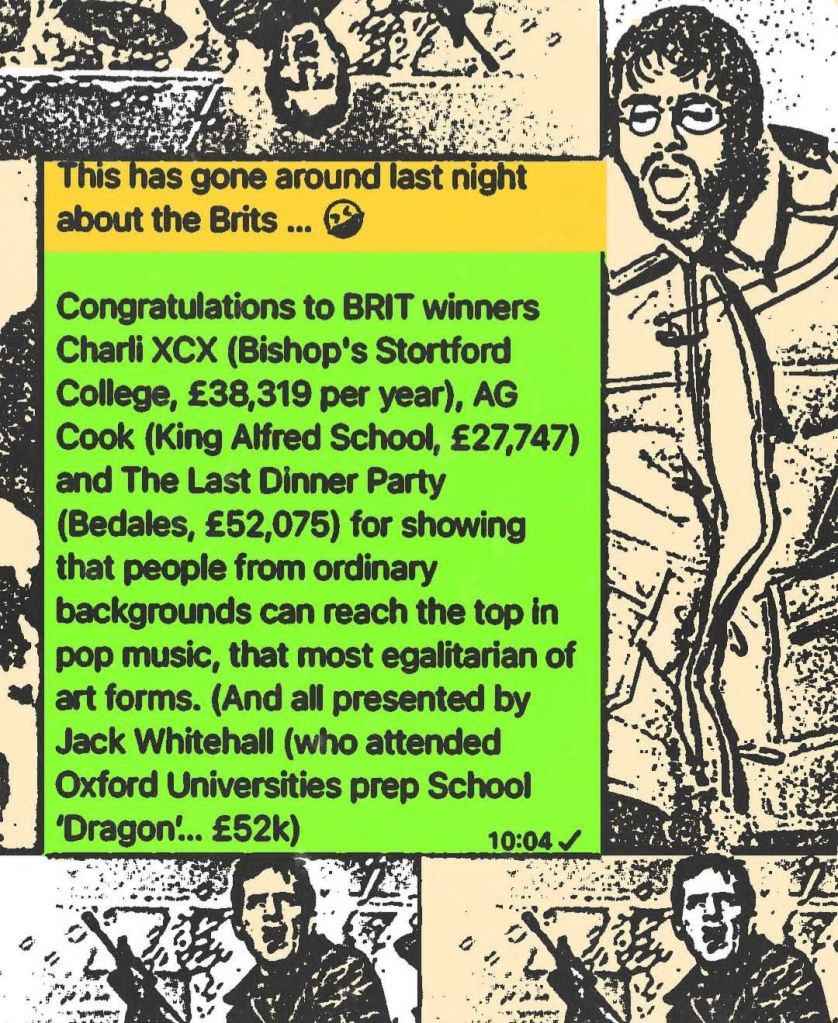
Historically, pop music has always been a working class endeavour, from US rock ‘n’ roll, to the Brit Beat boom in the ’60s, to disco, house music and beyond. At some point, pop and rock started getting a bit posh.
Where once a hard work ethic was available as an opportunity to climb up the charts, now it seems that we have an industry that aids those who are able to enter private education and, more importantly, well-connected.
Come the Noughties, and suddenly pop is littered with well-heeled kids who appeared to be slumming it. Lily Allen sang in a London accent, but seemingly swerved the fact that her dad was actor Keith Allen. So too, Jamie T, who mockneyed it up after getting his schooling at an expensive independent public school in Surrey.
When bringing this up, there’s usually a cry about how they worked just as hard as anyone to get their chart spots, but we all know that hard work + financial stability will get you further than someone with nothing to fall back on. The fact is, when you come from a poorer background, everything is coming out of your pocket from Day One.
Lola Young has come under fire for it, and responded with irritation.
She said: “People are saying I’m a nepo baby because my great aunt wrote The Gruffalo. I mean what kind of rubbish is that? I have so much to say on that which I can’t even talk about. But I’m not a nepo baby, I’m not an industry plant, there we go I said it. I’ve cleared that up for all those losers that want to comment rubbish on the internet. Just find something better to do, you’re sad, you’re lonely.”
“The thing is industry plant is just a term for other artists and other people to use who just don’t know what they’re doing in life and feel upset that someone else is having their moment. And if you are an industry plant, you’re not going to have your moment for that long, unfortunately. And maybe sometimes you will, it just doesn’t matter, none of these things matter. If someone’s got talent, then they’ve got talent.”
If someone’s got talent, is that enough? And is everyone with a notable relative garnering support from it? Is someone’s Great Aunt having success the same as someone’s immediately relative having money? Either way, in an oft-quoted study, it notes that in recent years, creative people from working class background represents as little as 8% of the creative industries.
With royalties from streaming being a problem across the whole of music, and the rising costs of touring, it is clear that those with well-connected parents and no financial worries behind them stand a better chance of making a living as a musician, artist, or whatever else.
Class diversity in the arts, it is clear, has been going backwards.
Look at dance music, and once a playground for the working classes, we have Fred Again, who attended Marlborough private boarding school in Wiltshire, the son of a barrister, descendent of a literal Baron, and various Earls, Marquesses and Dukes. Is that to say you can’t like his music? No, but it is to say that there needs to be more class equality in the recorded music industry, and it would be great if some of these monied families helped out those who aren’t afforded the chance to record with Brian Eno at 16 years old, like Frederick did.
The lack of opportunity to take risks is a huge barrier to working class kids, and if they’re working multiple jobs, not having the time or money to go for drinks to network and join a community, then they’re going to be at a huge disadvantage to those who are able to do an internship in central London, or get a leg-up from someone who can allow their kids to live at home while they try and get their songs heard.
There’s an inescapable truth that we’re seeing more opportunities going to posh kids. Ariana Grande’s mum is a Brooklyn bron CEO, and Taylor Swift’s dad is a stockbroker who afforded his daughter the chance at stardom by moving the whole family to Nashville.
With hip hop sailing dangerously close to CEO-speak of private jets and luxury watches long after the hustle has passed, with middle and upper class pop and indie stars filling stages, we’re long overdue some class revolt in music.
And you sense it coming.
 The Pop Corporation
Leave a comment