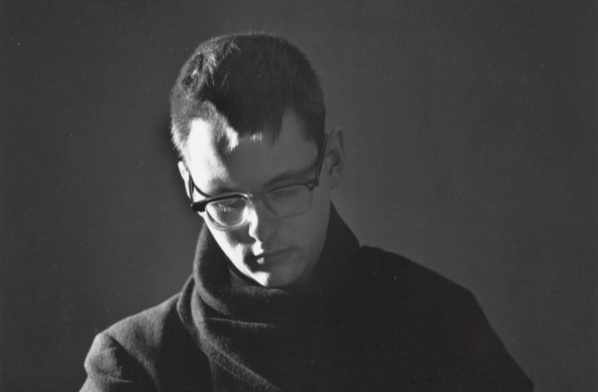
After his father bought a mine in Tucson, Arizona, Joseph Byrd grew up and found himself drawn to music. Initially, it was vibraphone and accordion in pop groups, he soon branched out into local TV arrangements and college jazz combos.
A talented kid, he found himself in a fellowship at Stanford, where he rubbed shoulders with Terry Riley, La Monte Young, and Steve Reich. He moved to NYC and began studying with John Cage – apparently Cage’s last – and found himself part of the proto Fluxus experiments and would end up having a show of his own compositions for the first time in Yoko Ono’s loft of all places.
Then the music started getting deliciously weird.
During these experimental times, he met Dorothy Moskowitz, becoming a radical Communist, writing liner notes and organising ‘happenings’, and soon enough, he would complete his most famous work – his group The United States of America.
Byrd said he wanted to create “an avant-garde political, musical rock group with the idea of combining electronic sound (not electronic music)” with “musical/political radicalism” and “performance art.”
No small feat.
Building their own ring modulators, recruiting more radicals and musical renegades, and the organised electronic rock shows and were completely unique, generating enough interest to attract the suits at Columbia Records.
1968 was a year of experimentations and wild ideas, but sadly, the world wasn’t quite ready for The United States of America debut LP, as sales stalled on its initial release.
The group played with the Velvet Underground, The Troggs and others, but to no commercial avail, and frustrated with the business side of it all, the band soon disintegrated.
Byrd: “The idea was to create a radical experience. It didn’t succeed. For one thing, I had assembled too many personalities; every rehearsal became group therapy. A band that wants to succeed needs a single, mutually acceptable identity. I tried to do it democratically, and it was not successful.”
Over time, the album would slowly grow in stature, eventually becoming a psychedelic classic – a masterpiece from the early frontiers of electronic music. Bands like Stereolab and Broadcast would revisit the blend of experimental rock with analogue electronics to huge critical acclaim.
For the few who heard the album, they would become evangelists, turning like-minded souls into devotees themselves. By the turn of the ’90s, it would be repressed countless times for those who needed to have a copy for themselves, to rave about it further, and switch anyone who would listen onto them.
Byrd would continue via the support of John McClure, head of Columbia’s Masterworks classical music division. This time, with the release of The American Metaphysical Circus.
Heavy electronics, classical and rock crashed headlong into each other once more, with Byrd stating: “It was a real chaotic time… frantic…. the songs had to be churned out.”
Again, those that heard the album fizzled with excitement at the effects and loops, not to mention the radical politics, taking aim at President Lyndon B. Johnson, retirement communities, and even finding the head space for a scratchy ragtime number and an 10+ minute acid trip.
In addition to all this, Byrd had side gigs, such as making a ghostly arrangement for Phil Ochs’ ‘Crucifixion’ with its eerie loops and electro distortion, for an utterly audacious sonic commentary on the assassination of JFK, leaving Ochs sounding like a man drowning in his own song.
There would be other rock gigs, as well as movie work, including Robert Altman’s fractious ‘H.E.A.L.T.H.’ which wouldn’t see the light of day until 1982, despite being made in ’79 than to boring manoeuvres with management at 20th Century Fox, and presumably Altman’s own wilful personality.
Later, he would work in TV with a theme for CBS Evening News, but more fun, developing electronic sounds used in toys made by Mattel, as well as voice effects used for drones in Douglas Trumbull’s Silent Running, which may well have been the inspiration for the sounds of R2-D2 in the Star Wars franchise.
He would eventually become a music teacher and sadly, passed away on November 2nd, 2025.
We remember him as an innovator of electronic sound, a musical radical, and someone who may have lacked the success of many of his peers, but was hugely important and influential irrespective of that.
We’ve lost a legend, but someone, somewhere right now, is listening to the sole album from The United States of America, and wondering how on Earth someone managed to make such an album all the way back in ’68, and starting a group in its honour.
 The Pop Corporation
Leave a comment