
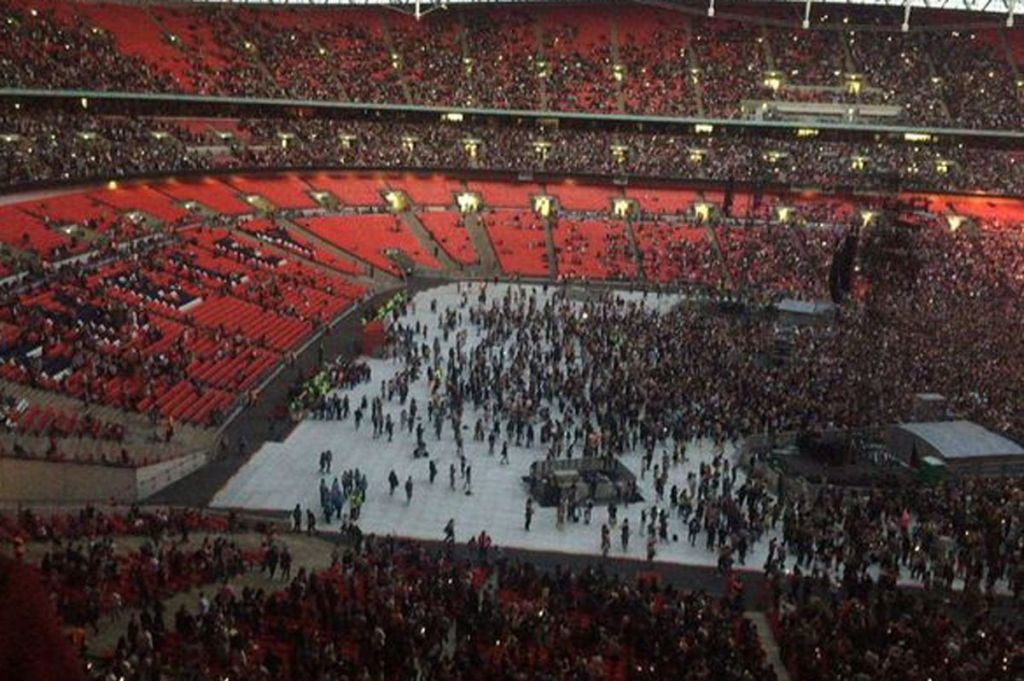
There’s a new phrase in the music industry – notably involving the touring circuit – called ‘Blue Dot Fever’. It references the amount of blue dots that appear on maps of arenas on the Ticketmaster website.
Post COVID lockdowns, big artists were keen to get out and play massive shows, and fans were keen to attend too, wanting huge communal experiences with their favourite artists.
Taylor Swift and Billie Eilish made hay while the going was good, with pricey tickets and selling out huge venues all over the world.
With the aforementioned artists, such is their popularity, it was hardly surprising that they were able to pack shows out while charging big bucks. However, it felt like there were smaller artists surprising everyone by booking themselves into very large venues, leaving onlookers pondering “what? Those guys? Are they that big? Well I never!“
There’s been a number of blind items detailing the use of companies that provide the service of ‘seat filling’, where fans get discounted tickets last minute, to fill out under-selling shows. These have largely flown under the radar, but more recently, the problem has gone public.
In just this past week, we’ve seen cancellations of tours from the Pussycat Dolls, Zayn Malik, Post Malone and prior to that, Meghan Trainer cancelled, and Van Halen frontman Sammy Hagar downsized a show from a 20,000 capacity show, to one that holds 3,500.
Small independent festivals are suffering too, and one thing that links all of these things is the price – fans are feeling the pinch all over the globe, and can no longer justify big ticket prices. It seems the recouping of costs from a lack of physical album sales is an excuse that fans no longer buy into, you’d assume.
The bubble seems to be slowly bursting everywhere.
If less big artists are choosing to play fewer shows, but to make money by playing arenas when they’d normally play a theatre show, fans now have to consider the additional costs of potentially getting hotels and the making a weekend of it, with the added cost of eating and drinking out on top of the show they’re planning on watching.
Travel, food, expensive tickets, hiked beer prices in arenas, for multiple people, and it isn’t surprising that music fans are deciding to opt out.
Look at the recent residences chosen by Harry Styles – instead of playing all over the country, he’s holing up for multiple shows in various cities, and US fans are looking at the combined costs of watching him in New York – one of the most expensive cities anywhere in the world – there’s been angry discourse online about how prohibitively expensive it’ll be to see their favourite singer.
Of course, Ticketmaster are playing it all down, but their monopoly on big shows may well be another reason why fans are choosing to swerve these arena shows through boycott or fatigue, and when you combine all these things, combined with an absence of some mid-sized venues in many places, it seems like we’re at the start of something that’ll transpire to show that something is changing.
And this isn’t wholly down to artist greed – the cost of touring has become dizzyingly expensive for them too, with the cost of travel hitting them in the pocket, and the cost of putting shows on spiralling. Musicians in the UK are also being hit with red tape and costs thanks to Brexit, making European shows nigh on impossible, and US tours are harmed by tariffs.
The band Los Campesinos shared a piece about the price they pay for putting on a tour (read here) where they detail how, before they’ve even set foot on North American soil, they’re almost £15,000 in the hole on bureaucracy alone.
Either way, whether it is the middle men trying to push their artists to go for a bigger cheque, some artists being greedy, a false equivalence from fudged streaming figures convincing labels their artists are bigger than they are, the cost of living crisis, the cost of tickets, ticketing monopolies, or simply the fatigue of big shows and wishing for smaller theatre and club shows, it feels like something is slowly turning.
There’s still huge sums of money being made in the live arena, but it feels top heavy and only a few artists are making hay while the sun shines in this post-COVID landscape.
In cities with multiple arenas, one of them is sure to suffer, and artists and labels are going to have to get a reality check about how they hit the road.


Leave a Reply